Press Release
December 8, 2011
The Think Club Publications Announces Book
of the Year Award for 2011
Bloomfield Hills, MI, December 8, 2011
The Think Club Publication has chosen 'Poorvabhas'
(http://www.poorvabhas.in/) for its 2011 Book
of the Year award. Think Club Publication, from
now on, will give this award to struggling and
lesser known writers in helping and encouraging
them in their endeavor. Think Club Publication
may also choose writers from languages other than
English. This year we chose the Hindi language.
The Think Club chose 'Poorvabhas' for the award
because of its effort in promoting fledgling Hindi
writers through its web publication. 'Poorvabhas'
has very effectively provided such a platform
to amateur writers in an effort to strengthen
Hindi language. Think Club Publications realizes
the value of this effort and thus presents the
Book of the Year award for 2011 to 'Poorvabhas.'
We especially congratulate Mr. Abnish Singh Chauvan
for creating such an effective platform for Hindi
writers and poets.
..........................................................................................................................................................................
Press Release
December 28, 2010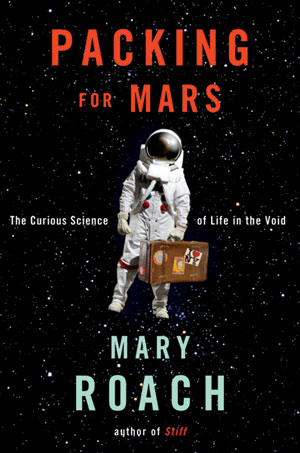
The Think Club Publications Announces Book
of the Year Award for 2010
Bloomfield Hills, MI, December 28, 2010
The Think Club Publication has chosen Packing
for Mars: The Curious Science of Life in the Void
by Mary Roach, published by W.W. Norton & Co.
as the Book of the Year for 2010. Think Club Publication
is a forum to encourage independent thinking among
fellow human beings. This annual award is given
to the author whose idea or ideas can contribute
to the resolution of contemporary human problems
based on his or her original and independent thinking.
The Think Club chose Packing for Mars as the Book
of the Year because the author provides us the
facts to think independently whether "Is Mars
possible" and "Is Mars Worth it?" She also gives
us enough ammunition to decide whether we should
be spending $500 billion on human Mars mission
or rely on cheap, reliable, robotic missions.
Roach starts with the premises that the human
body is inadequately designed for a long space
travel. Roach emphasizes this by listing the details
about disposing of human waste, controlling body
odor without washing, radiation from cosmic rays,
falling sick in space and bone loss. Besides the
physical problems, Roach also elaborates on emotion
and sex. After all human beings will be traveling
for a year (includes time on Mars) through darkness
of space cooped up with other mates who may be
getting on each others' nerves. Mary Roach describes
how it is possible to preview space without ever
leaving Earth. From the space shuttle training
toilet to a crash test of NASA's new space capsule
(cadaver filling in for astronaut), Roach takes
us on a surreally entertaining trip into the science
of life in space and space on Earth. But most
of all, Roach explains why a mission to Mars is
important for human spirit without hiding the
difficulties to get there. This is as important
to human endeavor and progress today as the hot
air balloon expedition by Mongolfier Brothers
was in 1780. Thus we present the Book of the Year
award for 2010 to Mary Roach for reminding us
that how spending on space program will give birth
to new innovations. Roach has aptly quoted Benjamin
Franklin to answer the skeptics, "What use is
a newborn baby?"
..........................................................................................................................................................................
Press Release
December 28, 2009
The Think Club Publications Announces Book
of the Year Award for 2009
Bloomfield Hills, MI, December 28, 2009
The Think Club Publication has chosen Here Comes
Everybody: the Power of Organizing without Organizations
by Clay Shirky, published by Penguin for the Book
of the Year Award for 2009. Think Club Publication
is a forum to encourage independent thinking among
fellow human beings. This annual award is given
to the author whose idea or ideas can contribute
to the resolution of contemporary human problems
based on his or her original and independent thinking.
The Think Club chose Here Comes Everybody for
this award because the author explains how common
people can and is making changes in society by
exerting freedom of speech by using new technologies
of social networking. The author illustrates how
a common man can really impact the social norms
and can make his or her voice heard without depending
on traditional media such as newspapers, radio
and television. Shirky illustrates how blogging
has enabled the common man to publish his or her
own viewpoints without depending on a traditional
press outlet. The change isn't a shift from one
kind of news institution to another, but rather
in the definition of news. News is no longer an
institutional prerogative. It's part of a communications
ecosystem, occupied by a mix of formal and informal
organizations and individuals. This extraordinary
book examines the ways that new communications
technologies enable groups of likeminded people
to form more easily than ever before, regardless
of geography. As the invention of the birth control
pill and the transistor have led to fundamental
changes in society, so too has the invention of
social media and the Web 2.0. Online social networks
have enabled productive, collaborative groups
to have their voices heard more effectively than
at any other time in history. Shirky makes sense
of the way that groups are using the Internet.
In a treatise that spans all manner of social
activity from vigilantism to activism, from Flickr
to Howard Dean, from blogs to newspapers, Shirky
clearly explains how every institution is prone
to being recast by the net, and how to manage
that change for the best possible outcome. He
picks perfect anecdotes to vividly illustrate
his points, then shows the larger truth behind
them. Shirky explains to the readers why the Internet
communication like Twittering matters. Thus, we
present the Book of the Year award for 2009 to
Clay Shirky for reminding us about how the vitality
and influence of groups of human beings can impact
businesses, society and our lives by using net-
enabled social tools.
..........................................................................................................................................................................
Press Release
December 28, 2008
The Think Club Publications Announces
Book of the Year Award for 2008
Bloomfield Hills, MI, December 28, 2008
The Think Club Publications has chosen The Trillion
Dollar Meltdown - Easy Money, High Rollers and
the Great Credit Crash by Charles R. Morris, published
by Public Affairs, New York for the Book of the
Year Award for 2008. Think Club Publication is
a forum to encourage independent thinking among
fellow human beings. This annual award is given
to the author whose idea or ideas can contribute
to the resolution of contemporary human problems
based on his or her original and independent thinking.
The Think Club chose The Trillion Dollar Meltdown
for this award because the author explains why
our economy is melting down in a layman's term
for those who are not in the financial services
industry. Moreover, the author's predictions were
made before we were hit by the present financial
storm. Mr. Morris used his independent thinking
to predict that it was time once again for the
pendulum to swing in the direction of more socially
conscious government intervention. Charles Morris
believes the era of market fundamentalism has
come to an end, just as Keynesian interventionism
came to an end in the 1970s. He estimates conservatively
that the recent defaults of residential mortgages,
corporate debt, credit card debt, and bonds will
be about $1 trillion. But this book was written
before even more recent revelations such as the
Bear Sterns insolvency. It is now estimated that
the bill could be 3 or 4 times as high. Morris
gives a brief but excellent history of events
that led up to the current credit crunch that
is paralyzing global financial markets. Disasters
have many fathers, but Morris lays much of the
blame on bond rating agencies, financial insurance
companies and the Federal Reserve under Alan Greenspan.
After 9/11 the Federal Reserve lowered the interest
rates below the rate of inflation, essentially
giving banks free money. Banks then lent money
for fees up front and then repackaged the loans
- turned them into securitized debt - and sold
them to investors. It was basically cost free
and risk free, so they lent money as if there
was no tomorrow. These securitized debts or CDOs
(collateral debt obligations) were sold and resold
throughout the global financial system and no
longer did anyone know how to measure their value
or their risk. Add to this the fact that homeowners
were using the rising equity of their homes as
ATMs and pumping another $4 trillion into the
economy. Also add to the mix $700 billion annual
trade deficit that indicates that much more consumption
over production. The party was really in full
swing. Morris is not a liberal ideologue but a
former banker who comes to his conclusions based
on objectivity, knowledge, and lucid thought.
The integrity of his independent thinking shines
through every page. Thus, we present the Book
of the Year award for 2008 to Charles R. Morris
for bringing the message to regular folks in an
honest and understandable way instead of hiding
behind a curtain of mathematical complexity.
..........................................................................................................................................................................
Press Release
December 28, 2007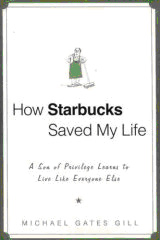
The Think Club Publications Announces
Book of the Year Award for 2007
Bloomfield Hills, MI, December 28, 2007
The Think Club Publications has chosen
How Starbucks Saved My Life – A Son
of Privilege Learns to Live Like Everyone Else
by Michael Gates Gill, published by Gotham
Books for the Book of the Year Award for 2007.
The Think Club Publications is a forum to
encourage independent thinking among fellow human
beings. This annual award is given to the author
whose idea or ideas can contribute to the resolution
of contemporary human problems based on his or
her original and independent thinking.
The Think Club chose How Starbucks Saved
My Life for this award because the author,
an Ivy League graduate discovers that no profession
is menial and professes respect towards people
of all ages and races. Gill preaches what he really
practiced, the lessons of life he learned in his
sixties from a young black woman in her twenties.
Gill actually stepped down from his Yale and top-ad-exec
background, to don a Starbucks apron, serving
coffee and cleaning sinks and toilets.
This is a real-life story of the author himself
about how he found Starbucks, or rather it found
him. One desolate day, Gill filled out an application
and was hired to work in a Manhattan store. He
shamefacedly donned a green barista’s apron
and entered a world in which he was a minority:
His colleagues were African-American and decades
younger, and he was the least skilled person in
the room. Gill becomes adept at his new job; along
the way, he muses on his breathtakingly biased
former self: Race, social class, age—you
name it, he condescended about it from his former
“position at the top of American society”
as a “member of the Ruling Class.”
By memoir’s end, the reader will have learned
much about life as a barista, from company policy
to coffee tasting. Gill compares his plight to
that of baby boomers nationwide, and reflects
on his new perspective. This barista’s story
ends on an up-note, though; he transfers to a
Starbucks near his apartment in a suburb, and
has a movie in development with Tom Hanks as the
lead. It does seem as if his Starbucks job gave
Gill new hope; it will be interesting to see if
he remains a barista, and whether he retains the
lessons he learned as a Starbucks employee.
In short the story follows the life changing
experiences that takes the author from being a
Creative Director at J Walter Thompson to unemployment
and despair. The book follows the twists and turns
that lead Mr. Gill to become a barista in a New
York Starbucks rediscovering self-respect and
happiness in his new life. Thus, we present the
Book of the Year award for 2007 to Michael Gates
Gill for bringing the message that no work is
menial and no one should be discriminated against
on the basis of age and race.
..........................................................................................................................................................................
Press Release
December 28, 2006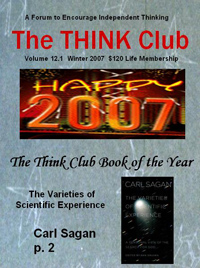
The Think Club Publications Announces
Book of the Year Award for 2006
Rochester Hills, MI,
December 28, 2006 The Think Club Publications
has chosen The Varieties of Scientific Experience:
A Personal View of the Search for God by
Carl Sagan, edited by Ann Druyan and published
by Penguin Press for the Book of the Year Award
for 2006. The Think Club Publications is a
forum to encourage independent thinking among
fellow human beings. This annual award is given
to the author whose idea or ideas can contribute
to the resolution of contemporary human problems
based on his or her original and independent thinking.
The Think Club chose The Varieties of Scientific
Experience for this award because of the
author’s efforts in bringing a balance between
science and religion in today’s cynical
environment. As a scientist, Sagan's most important
contribution wasn't any specific theories or discoveries,
but rather his ability to popularize science and
make it accessible to the layperson. Once again,
in this book, he succeeds in doing this. In the
faith-and-reason conflict, Sagan was very much
on the side of reason, although he allowed room
for faith.
This is, essentially, a book on the existence
of God, encompassing a collection of lectures
Carl Sagan gave quite sometime ago and then edited
by his wife, Ann Druyan. It combines the reason
and logic of some of the best arguments against
strict religious dogmas with the wit of Carl Sagan.
Sagan approaches religion from his background
as a scientist. He takes complex scientific ideas
and explains them learnedly and eloquently. He
covers matters such as the origin of the universe
and of the planets, the age of the universe, geological
time, the origin of life, the likelihood of finding
life on other planets in other galaxies, UFO's,
and much else. Therefore, we present the Book
of the Year award for 2006 to Ann Druyan and her
late husband Carl Sagan for their courage in bringing
equilibrium between science and religion, especially
in today’s religious climate.
..........................................................................................................................................................................
2005 Book of the Year
Writing Home
Cindy La Ferle's poignant collection
of essays reveals the extraordinary in the ordinary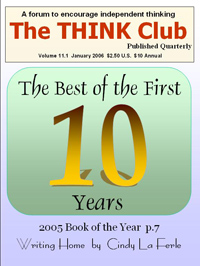
Bloomfield Hills, MI—The Think Club,
a forum to encourage independent thinking among
fellow human beings, chooses Writing Home,
written by Cindy La Ferle for the Book
of the Year award (first published by Hearth
Stone Books, in 2005). This annual award is
given to the author whose idea or ideas can
contribute to the resolution of contemporary
human problems based on his or her original
and independent thinking.
The Think Club chose Cindy La Ferle
for its 2005 award because of her belief in
common sense and self-knowledge. Her memoirs
and stories in the collection, Writing Home
emphasizes the fact that each of us is
a unit of the society we live in and of the
world at large. She states this fact at the
outset in the preface of the book, “Baking
bread in my kitchen while U.S. military forces
bombed Baghdad, I renewed my commitment to being
a peacemaker in my own community.” Her
views are her own and they never seem to be
dictated by outside influences. Her realizations
come from her own convictions. She ponders her
son’s thorny struggle for independence,
and what it means to be a wife, mother, and
homemaker in a culture that often marginalizes
traditional feminine roles. She seeks answers
to those questions from within – without
anyone doing the thinking for her.
Her revelations can be the key to happiness
in today’s rat race where we look up to
so called role-models for answers. She rebukes
us by telling, “Even today, few men or
women will admit they enjoy doing anything remotely
domestic, unless it makes them as rich and famous
as Martha Stewart.” She challenges us
to be proud for what we are. While growing up,
she never considered Barbie (38-18-34) as a
threat to her self-esteem. At the same time
she admired Barbie for being exactly what she
was – a gal with options who never took
herself too seriously.
Our society seems to make a big deal of teenagers’
tantrums. Cindy also takes that in stride. She
reassures us that our teenagers don’t
come from different planets. She understands
that the teenagers feel trapped between the
growing need for independence and the secret
wish to cling to childhood – an agonizing
conflict. That’s why the teenagers will
hug their parents in the kitchen when nobody
is looking. Her answer to this dilemma is the
much needed virtue called patience. Writing
Home reads like a panacea to all our social
problems. We all seem to be stressed about entertaining
people at our home. Cindy comes to the rescue
again with her self-knowledge and common sense,
“The quickest way back to sanity is to
remind ourselves that most people are easily
pleased with home cooking and real conversation.”
One of the special qualities of this book is
that she has written every piece to find out
what she thinks and to know where she stands.
Writing Home is full of lessons on
how to lead our lives. It teaches us to realize
that everyone doesn’t need to like us
in order for us to be acceptable. The truth
is, people who care about us really do want
to help – if only we’d drop the
mask of total self-sufficiency and admit that
we’re not all-powerful all the time. Rejection
and its evil twin, criticism, are part and parcel
of the working life. We should not care much
for either of them.
Ultimately, Cindy likes to believe that our
little lives have meaning. She sums it up very
poignantly and meaningfully, “But the
longer I live, the only thing I know for certain
is this: Everything I hold sacred is hidden
right here in plain sight.” Cindy presents
us the challenge to be our best as people and
wants us to “enjoy the happiness of the
world we live and love.” Therefore,
we present the Book of the Year award for 2005
to Cindy La Ferle (Writing Home) for
her efforts in simplifying life for all of us
based on her independent thinking.
..........................................................................................................................................................................
Press Release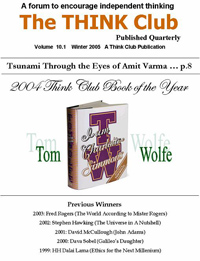
The Think Club chooses
I Am Charlotte Simmons
By Tom Wolfe
As the book of the year for 2004
December 15, 2004
Bloomfield Hills, MI — The Think
Club, a forum to encourage independent
thinking among fellow human beings, chooses
I Am Charlotte Simmons, a penetrating
and entertaining novel written by America’s
brilliant story teller, Tom Wolfe (first published
by Farrar, Straus and Giroux in 2004)
for the Book of the Year award. This annual
award is given to the author whose idea or ideas
can contribute to the resolution of contemporary
human problems based on his or her original
and independent thinking.
The Think Club chose Tom Wolfe’s
novel for its 2004 award because of his underlying
message to parents – to know and understand
what goes on in the lives of their innocent
children in big schools and question those practices.
The undergraduate schools are the breeding grounds
for life’s immoralities where the kids
are provided a country club atmosphere to indulge
in promiscuous sex, drugs, alcohol, vulgarities
and parental disrespect in the name of individuality
and liberalism.
Wolfe creates a world of characters
that are brought vividly to life, with conflicts
and problems that are so painfully true. Dupont
University, with its Olympian halls houses the
cream of America’s youth. There comes
brilliant Charlotte Simmons, a sheltered freshman
from North Carolina. Charlotte soon learns,
to her mounting dismay, that the pleasure of
the body takes absolute precedence over the
life of the mind. At Dupont, students sleep
around with indiscriminate zeal. Boys and girls
are forced to share the same bathrooms in the
name of gender equality. The university administration
is utterly indifferent to anything except the
dogmas of political correctness.
We then race through plots involving students’
candy-colored interactions with each other and
inside their own heads. Charlotte is a prodigy
from a conservative Southern family; Jojo is
a white basketball player struggling with race,
academic guilt and job security; Adam, a student
reporter cowed by alpha males. Through these
characters, Wolfe has woven a virtual recitation
of facts, albeit colorful ones – athletes
getting a free pass boasting casual sex and
machismo-fueled violence. The novel seems intent
on shocking, but little here will surprise even
those well past their term-paper years. Wolfe’s
descriptions are shockingly brilliant such as,
a basketball game seen from inside a player’s
head.
With his eye for detail,
Tom Wolfe draws on extensive observation of
campuses across the country to immortalize college
life in the 2000s. Wolfe spent years researching
the lives and customs of similar characters
at major U.S. universities before creating his
own fictional characters. I Am Charlotte
Simmons is a triumph of America’s
master chronicler who has authored such narratives
as The Electric Kool-Aid Acid Test,
The Right Stuff, The Bonfire of
the Vanities, and A Man in Full.
Wolfe has brought the culture of today’s
university scene to us as a waking call. It’s
amazing to notice how close to the truth Wolfe
gets. The conflicts and problems dealt in the
book are so painfully universal that the book
will surely scare an awful lot of parents who
have, so far, chosen to remain dormant. And
so it is with great pleasure that we present
the Book of the Year award for 2004 to Tom Wolfe
for creatively urging us to make the administrators
of the big educational institutions to concentrate
on education and set codes of conduct according
to the wishes of the parents who pay about $120,000
for tuition alone.
..........................................................................................................................................................................
Think book of the Year
Press Release
The Think Club chooses
The World According to Mr. Rogers
By Fred Rogers
As the book of the year for 2003
December 15, 2003
Bloomfield Hills, MI — The Think Club,
a forum to encourage independent thinking among
fellow human beings, chooses The World According
to Dr. Rogers, a collection of thoughts and
ideas written and spoken by the late Fred Rogers
(first published by Hyperian in 2003) for
the Book of the Year award. This annual award
is given to the author whose idea or ideas can
contribute to the resolution of contemporary human
problems based on his or her original and independent
thinking.
The Think Club choses Fred Rogers’
book for its 2003 award because of his emphasis
on sharing what came naturally to him –
his belief in basic human nature and his reassurance
about its goodness to all of us based on his own
original thinking and especially his observation
about the scary realities of life, particularly
since September 11th. He writes, “When I
was a boy and I would see scary things in the
news, my mother would say to me. ‘Look for
the helpers. You will always find people who are
helping.’ To this day especially in times
of ‘disaster’, I remember my mother’s
words and I am always comforted by realizing that
there are still so many helpers-so many caring
people in this world.”
In this age of mistrust and terrorism,
his message is very timely and comforting. His
emphasis on honesty, cooperation, compassion and
that people will like you the way you are is remarkable
and exceptional.
In a world that, at times, seems to be full of
gray areas, Fred Rogers writes, “It’s
not the honors and the prizes and the fancy outside
of life that ultimately nourish our souls. It’s
the knowing that we can be trusted, that we never
have to fear the truth, that the bedrock of our
very being is firm.”
This small volume collects many of his writings
– from the songs he wrote for the show to
his acceptance speech at the Television Hall of
Fame – organized around themes like “The
Courage to Be Yourself” and “We Are
All Neighbors.” The format is occasionally
tantalizing and brilliant. His most touching comment
came when he said, “I’m proud of you
not for the times you came in second, or third,
or fourth, but what you did was the best you had
ever done.”
Ultimately, one of the beauties of this book
is the marvelous human spirit behind it. Rogers
taught valuable lessons about keeping one’s
promises, finding strength through helping others
and not being afraid to cry. Fred Rogers challenge
us to be our best as people and as thinkers.
And so it is with great pleasure that we present
the Book of the Year award for 2003 to the late
Fred Rogers for teaching us to think independently
at a time when we all seem to be unsure about
human nature
..........................................................................................................................................................................
Press Release
The Think Club chooses
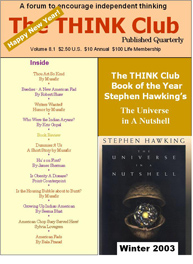
The Universe in A Nutshell
By Stephen Hawking
As the book of the year for 2002
December 15, 2002
 Bloomfield
Hills, MI—The Think Club, a forum to encourage
independent thinking among fellow human beings,
chose The Universe in A Nutshell, authored by
Stephen Hawking for the Book of the Year award
(first published by Bantam Books, in 2001). This
annual award is given to the author whose idea
or ideas can contribute to the resolution of contemporary
human problems based on his or her original and
independent thinking. Bloomfield
Hills, MI—The Think Club, a forum to encourage
independent thinking among fellow human beings,
chose The Universe in A Nutshell, authored by
Stephen Hawking for the Book of the Year award
(first published by Bantam Books, in 2001). This
annual award is given to the author whose idea
or ideas can contribute to the resolution of contemporary
human problems based on his or her original and
independent thinking.
The Think Club chose Stephen Hawking for its
2002 award because of his emphasis on how knowledge
expansion can carry us forward faster to solutions
than our geometric physical expansion. The future
may well include major changes in the physical
qualities of what a human is, a better connection
between our brains and our electronic extensions,
and the need to solve a delicate problem of where
we should design for speed . . . and where for
handling more complexity.
Professor Hawking has combined many perspectives
to show how Einstein’s special and general theories
of relativity have been updated to explain the
big bang, black holes, and an expanding universe;
superstring theory; p-branes; how many dimensions
the universe has; whether the future can be predicted
in a deterministic way; whether time travel is
possible; how science will transform our biological
and thinking futures in the context of Star Trek
technology; and M-theory to consider whether “we
live on a brane or are we just holograms?”
Those who wonder what science has to say about
religious ideas will find this book valuable,
for Professor Hawking is unafraid to address questions
about whether there can be a beginning to the
universe in a scientific sense. What could or
could not have preceded the big bang?
One of the lessons of this book is that much
of what we think of as “fact” is merely a convenient
approximation of a more complex circumstance.
Newton’s thinking about gravity is a good example.
Where in your life do you need to know with as
much precision as possible, and where will approximations
work just fine? Making that choice well can be
the most important talent one can develop.
Ultimately, one of the beauties of this book
is the marvelous human spirit behind it. Professor
Hawking presents us the challenge to be our best
as people and as thinkers, therefore, we present
the Book of the Year award for 2002 to Stephen
Hawking for maintaining his independent thinking
while, at the same time, trying to understand
for himself and explain to his readers the complexities
of science.
..........................................................................................................................................................................
Press Release
The Think Club chooses
John Adams
by David McCullough
as the book of the year for 2001
December 15, 2001
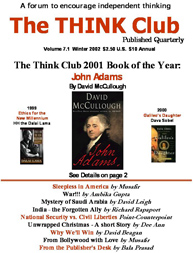 Bloomfield
Hills, MI—The Think Club, a forum to encourage
independent thinking among fellow human beings,
chose John Adams, authored by David McCullough
for the Book of the Year award (first published
by Simon & Schuster, in 2001). This annual award
is given to the author whose idea or ideas can
contribute to the resolution of contemporary human
problems based on his or her original and independent
thinking. Bloomfield
Hills, MI—The Think Club, a forum to encourage
independent thinking among fellow human beings,
chose John Adams, authored by David McCullough
for the Book of the Year award (first published
by Simon & Schuster, in 2001). This annual award
is given to the author whose idea or ideas can
contribute to the resolution of contemporary human
problems based on his or her original and independent
thinking.
Portrait of John AdamsThe Think Club chose David
McCullough for its 2001 award because the ideas
expressed by him in John Adams provide a practical
solution to conflicts going on around us. In a
time when our perception of the world is changing
and many are re-evaluating our nation’s role in
the world, visiting the birth of our country and
the ideals under which it was formed can be a
cathartic experience.
Mc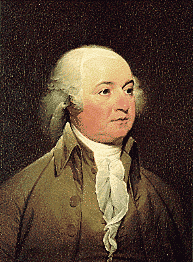 Cullough’s
treatment of the life and times of John Adams
provides a unique view into what is truly a unique
and amazing time period, one which literally changed
the world, and is still a major force in shaping
today’s world events. By focusing on John Adams,
the often forgotten and least understood figure
in revolutionary America, McCullough is able to
present the genesis of the “American Experiment”
from the eyes of a man with a true passion for
liberty, who maintained his integrity and principles
through what was probably the most turbulent and
unstable political period the world had yet seen. Cullough’s
treatment of the life and times of John Adams
provides a unique view into what is truly a unique
and amazing time period, one which literally changed
the world, and is still a major force in shaping
today’s world events. By focusing on John Adams,
the often forgotten and least understood figure
in revolutionary America, McCullough is able to
present the genesis of the “American Experiment”
from the eyes of a man with a true passion for
liberty, who maintained his integrity and principles
through what was probably the most turbulent and
unstable political period the world had yet seen.
Adams, who describes himself as an average man
caught up in extraordinary events, was perceptive
enough to understand that he was living through
great events and had enough foresight to preserve
most of his writings. Along with writings from
his wife Abigail, his friend and political rival
Thomas Jefferson, and excerpts from a multitude
of other sources from the time period, we are
able to gain a better perspective on the origins
of our nation.
Most of all, McCullough has proven the strength
of independent thinking through the characterization
of John Adams. Adams believed strongly in opposition
to slavery. He also believed in the rule of law.
David McCullough’s John Adams has the sweep and
vitality of a great novel. It is both a riveting
portrait of an abundantly human man and a vivid
evocation of his time, much of it drawn from an
outstanding collection of Adams family letters
and diaries. In particular, the more than one
thousand surviving letters between John and Abigail
Adams, nearly half of which have never been published,
provide extraordinary access to their private
lives and make it possible to know John Adams
as no other major American of this founding era.
The man who was so ordinary when compared to
the revolution’s extraordinary figures showed
a profound commitment to the country he served
in so many pivotal ways. As both ambassador and
president, Adams accepted responsibilities for
which he’d had little experience, recognizing
that few people in this young country were any
better prepared for the challenges inherent in
this experiment in democracy. Through the conviction
and strength of his independent thinking, Adams
certainly rose to the challenges of his turbulent
times. As a fledgling lawyer from a humble Massachusetts
farm family, he seemed to follow an unerring moral
compass, from his defense of British soldiers
in the Boston Massacre on legal grounds, to his
aggressive arguments for independence, well ahead
of the curve of public sentiment. One of the most
vocal advocates of the Declaration of Independence,
he was the overseas ambassador charged with rallying
foreign support to the fledgling nation.
We can certainly learn from the courage, conviction
and experiments of John Adams. John Adams points
us in the right direction. Therefore, we present
the Book of the Year award for 2001 to David McCullough
for depicting the life of John Adams, an independent
thinker.
..........................................................................................................................................................................
 Press
Release Press
Release
P.O. Box 451, Bloomfield Hills, MI 48303-0451
Galileo’s Daughter by Dava Sobel Is Chosen as
the Book of the Year by The Think Club
Bloomfield Hills, Michigan, December 15, 2000:
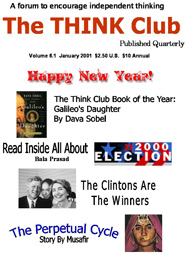 The Think Club, a forum to encourage independent
thinking among fellow human beings, chose author
Dava Sobel’s book, Galileo’s Daughter, published
by Walker & Company, New York, as the book of
the year for 1999-2000. This is the second year
of the award. Last year the honor went to H.H.
the Dalai Lama for his book, Ethics for the New
Millennium.
The Think Club, a forum to encourage independent
thinking among fellow human beings, chose author
Dava Sobel’s book, Galileo’s Daughter, published
by Walker & Company, New York, as the book of
the year for 1999-2000. This is the second year
of the award. Last year the honor went to H.H.
the Dalai Lama for his book, Ethics for the New
Millennium.
This annual award is given to the author whose
work or ideas inspire independent thinking among
fellow human beings. Although Sobel may not have
intended to promote the theme of independent thinking,
being a master storyteller, she has brought to
life the struggle of Galileo in expressing his
thinking, which was contrary to the public and
institutional opinions of the time. Sobel sums
it up in describ ing
Galileo’s most famous moments: ing
Galileo’s most famous moments:
There was only one trial of Galileo, and yet
it seems there were a thousand--the suppression
of science by religion, the defense of individualism
against authority, the clash between revolutionary
and establishment, the challenge of radical new
discoveries to ancient beliefs, the struggle against
intolerance for freedom of thought and freedom
of speech. No other process in the annals of canon
or common law has ricocheted through history with
more meanings, more consequences, more conjecture,
more regrets (p. 232).
It is difficult today--from a vantage point of
insignificance on this small planet of an ordinary
star set along a spiral arm of one galaxy among
billions in an infinite cosmos--to see the Earth
as the center of the universe. Yet that is where
Galileo found it (p. 49).
Galileo, either through nurture, nature, or a
combination of the two, developed a personal philosophy
much like his father’s. His father wrote in Dialogue
of Ancient and Modern Music the following:
It appears to me that they who in proof of any
assertion rely simply on the weight of authority,
without adducing any argument in support of it,
act very absurdly. I, on the contrary, wish to
be allowed freely to question and freely to answer
you without any sort of adulation, as well becomes
those who are in search of truth (p. 17).
Galileo spent a great deal of his life at odds
with the teachings Aristotle who was by the 16th
and 17th centuries incorporated not only into
the philosophies and thoughts of the educated
but also part and parcel to many doctrines and
dogmas of the Catholic Church. Saint Thomas Aquinas
was largely responsible for melding Aristotle
with Christian doctrine even though Aristotle
lived hundreds of years before Jesus. Galileo
wanted to prove things via superior methodologies.
He relied on experiment whenever possible.
Sobel has done a remarkable job through the beauty
of her writing and by paying close attention to
fine details resulting in a work that not only
feels real but also glorifies the courage and
ingenuity of a great independent thinker. The
Think Club feels honored in presenting its book
of the year award for 1999-2000 to Dava Sobel
for her work, Galileo’s Daughter.
..........................................................................................................................................................................
Press Release
December 1, 1999
The Think Club chooses “Ethics for the
New Millenniun” by HH Dalai Lama as the book of
the year for 1999
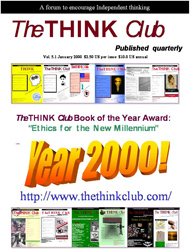 BloomfieldHills,
MI—The Think Club, a forum to encourage independentthinking
among fellow human beings, chose Ethics for the
New Millennium, authored by His Holiness the Dalai
for the Book of the Year award (first published
by Riverhead Books, New York in 1999).This annual
award is given to the author whose idea or ideas
can solve any aspect of contemporary human problems
based on his or her original and independent thinking. BloomfieldHills,
MI—The Think Club, a forum to encourage independentthinking
among fellow human beings, chose Ethics for the
New Millennium, authored by His Holiness the Dalai
for the Book of the Year award (first published
by Riverhead Books, New York in 1999).This annual
award is given to the author whose idea or ideas
can solve any aspect of contemporary human problems
based on his or her original and independent thinking.
The Think Club chose HH the Dalai Lama for its
1999 award because the ideas expressed by him
in Ethics for the New Millennium provide a practical
solution to religious conflicts going on around
us. His Holiness’ solutions are based on his own
observations and experiences and not dictated
by any fanatic ideology.
It is unusual for the head of a religion to
speak his mind so candidly against religious dogma
without the fear of punishment and criticism by
the establishment. It takes courage for an exiled
monk to declare that following positive ethical
conduct is better than following an organized
religion. The book is full of humble but dauntless
passages like the following:
“Not that 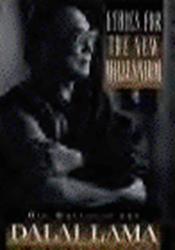 reader
should suppose that, as Dalai Lama, I have any
special solution to offer… There are other faiths,
and other cultures, no less capable than mine
of enabling individuals to lead constructive and
satisfying lives… What is more, I have come to
the conclusion that whether or not a person is
a religious believer does not matter much. Far
more important is that they be a good human being…
These may seem unusual statements, coming as they
do from a religious figure…I am, however, Tibetan
before I am Dalai Lama, and I am human before
I am Tibetan.” reader
should suppose that, as Dalai Lama, I have any
special solution to offer… There are other faiths,
and other cultures, no less capable than mine
of enabling individuals to lead constructive and
satisfying lives… What is more, I have come to
the conclusion that whether or not a person is
a religious believer does not matter much. Far
more important is that they be a good human being…
These may seem unusual statements, coming as they
do from a religious figure…I am, however, Tibetan
before I am Dalai Lama, and I am human before
I am Tibetan.”
According to HH the Dalai Lama, all religions
have contributed in the development of spiritual
practices and all religious faiths demand them.
According to the book, spiritual practice entails
an ethical practice. Moreover, one shouldn’t forget
that our happiness is bound up with the happiness
of others.
The messages expressed in Ethics for the New
Millennium come as a timely solution to the strife-ridden
world where the seeds of intolerance and hatred
can be found in some of the teachings of many
faiths, for example those which assert the exclusiveness
of the faith, or superiority of the faithful over
the infidel, the heathens or simply those who
are different.
We can certainly draw common ethics from the
teachings of all faiths: a single set of ethics
that all faiths could accept as their own. Ethics
for the New Millennium points us in that direction.
Therefore, we present the Book of the Year award
for 1999 to His Holiness the Dalai Lama for his
book Ethics for the New Millennium with due respect
and humility.
Previous Winners
2005: Writing Home by Cindy
La Ferle
2004: I Am Charolette
Simmons by Tom Wolfe
2003: The World According
To Mr. Rogers by Fred Rogers
2002: The Universe In
A Nutshell by Stephen Hawkings
2001: John Adams
by David McCullough
2000: Galileo's Daughter
by Dava Sobel
1999: Ethics for the
Next Millenium by HH Dalai Lama
|